Staff surveys have the potential to be one of the most powerful tools in a school leader’s kit. But they only work if people trust that their voices are actually heard; trust that is hard-won and easily lost. Whether you’re setting up your first survey or picking things up after a gap, this post walks you through how to get started with confidence.
Previous posts cover other questions we are often asked at the start — from the pros and cons of annual vs pulse surveying to planning your survey calendar and coordinating across a Trust. But the question we get asked most often is simply: where do we begin?
Last survey guilt – it’s not too late to share – or is it?
Most leaders who’ve let survey results go unshared know exactly what we mean by this. You ran a survey, life got busy, and now months have passed without any follow-up. Sound familiar?
The good news is that you have options — and the right one depends on how much time has passed.
1. Talk about it. If the results are still reasonably relevant, share them — even now. Pull out a few headlines, be honest about what has and hasn’t changed since, and use it as a springboard for launching your next survey. Framing it positively (“Here’s what we heard, here’s where we are now”) shows staff that their input wasn’t wasted.
2. Acknowledge it and move on. If too much has changed for the old results to be useful, say so. A brief, honest apology goes a long way. Rather than dwelling on dated data, channel that staff energy into shaping the next survey — invite input on what questions to ask, or set up working groups around key themes you know need attention.
3. Start fresh. Sometimes a previous survey really does feel too far back to revisit — perhaps it was two or more years ago, a significant proportion of staff are new, or leadership has changed. If so, it’s fine to move on without looking back. Just make sure you commit to doing it properly this time: share a clear timeline for follow-up before you even launch.
Setting up a first (or first in ages) survey
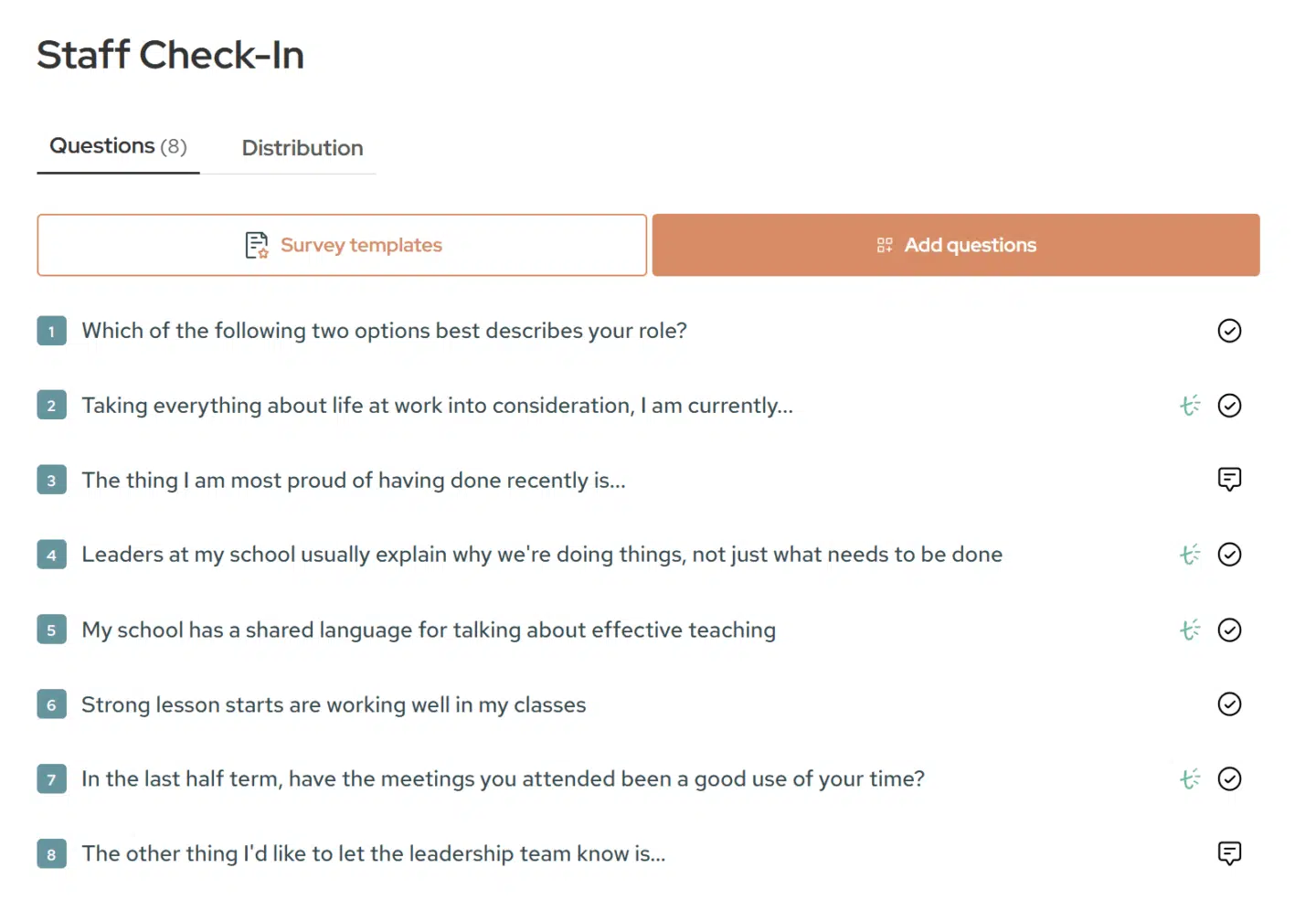
If you’re starting from scratch, we’d suggest keeping your first survey short and focused. Here’s a format that works well:
An open positive question. Something like “What’s something you’ve done lately that you feel proud of?” or “I’m particularly grateful for…” These questions set a constructive tone and often surface insights that closed questions miss. Our platform includes a bank of ready-made positive questions, or you can write your own — the report will highlight key themes automatically, and you can view full responses and create word clouds online.
One or two benchmarkable questions. Ask about overall morale, engagement, communication or leadership. These are particularly valuable when asked consistently over time, so consider questions you may want to revisit — either ones you’ve used before, or ones you’re committing to track going forward.
One or two questions about current priorities. Perhaps you’re focusing on lesson starts, or have launched a new coaching programme. What feels most relevant to track or take views on? Dip into our question bank or write your own. Asking the same question again later in the term or year is a great way to chart progress.
An open improvement question. Something like “Is there anything else you’d like the leadership team to know?” gives staff the chance to raise what matters most to them right now — and often produces the most valuable responses of all. Again, there are lots of suggestions in the portal.
Here’s an example:
Making it meaningful: diarise your next steps
The single biggest reason surveys fail isn’t poor questions — it’s what happens (or doesn’t happen) afterwards. Here’s how to set yourself up for success before you even launch:
Block out time for completion. Allocating a slot in a staff meeting or training session is one of the most effective ways to boost response rates. Build in enough time, and don’t be afraid to extend the closing date if needed.
Block out time to share back. Even a few words in a briefing — thanking people for responding and sharing two or three headlines — makes a real difference. And don’t feel you have to report only on what you’re acting on. Being honest about what you’re not taking forward, and why, builds just as much trust as sharing the wins.
Finally, think ahead to what comes next. Will this be a one-off annual survey, or might shorter check-ins between now and then add value? Having a rough plan — even a loose one — makes it far more likely that surveying becomes a sustainable habit rather than a one-time effort.
Further support
We love talking about surveying! You are always welcome to book a call to discuss your next survey or give any support.
If you are already using the service, get in touch via hello@schoolsurveys.com or follow the support call link in the newsletters.
If you aren’t yet using our School Surveys platform, we’d be happy to show you the platform and discuss your situation. Click here to book a demo call.