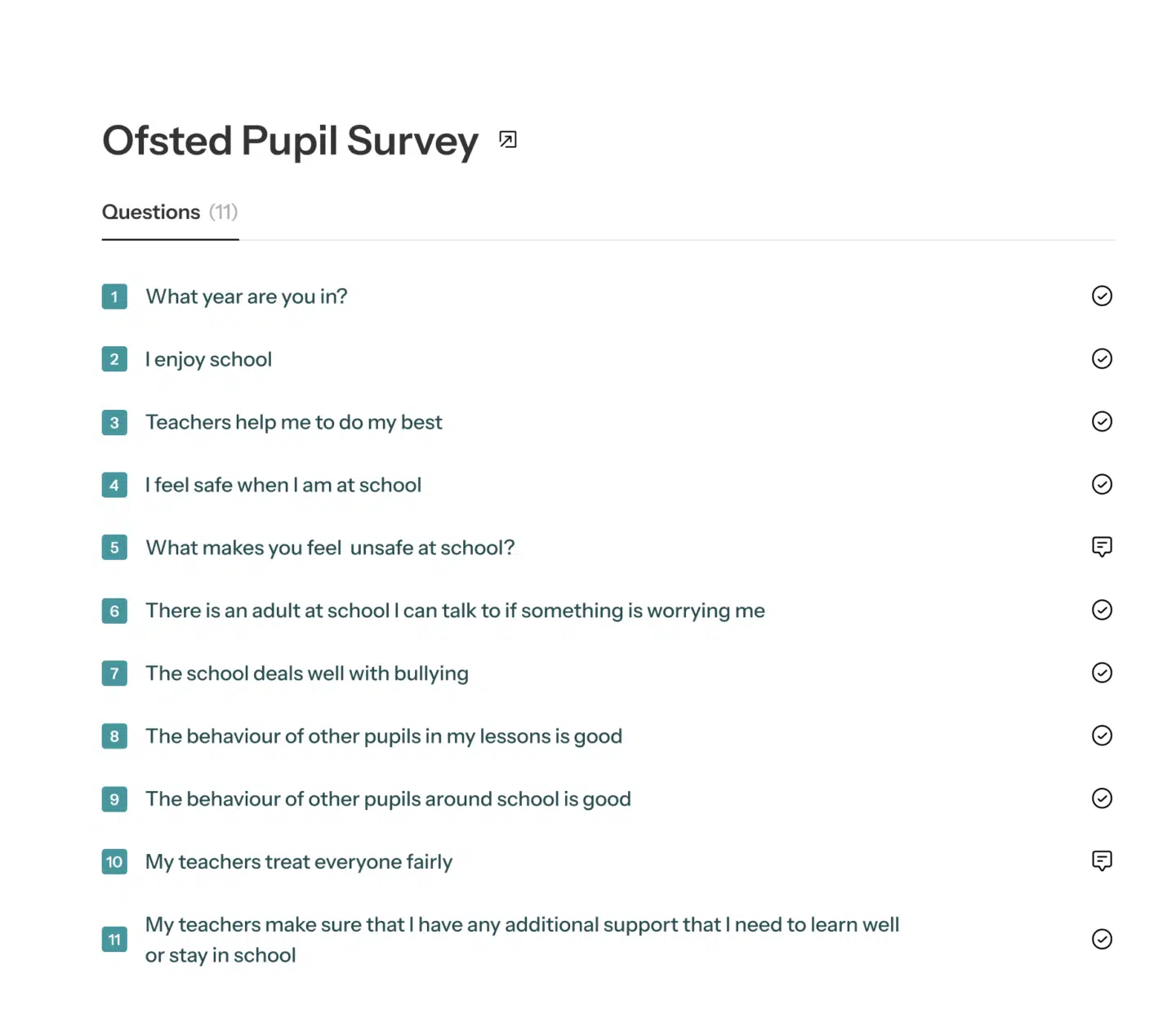
During an inspection, the Ofsted staff (and pupil) questionnaire is administered online by the school at Ofsted’s instruction. Ofsted will give the school details of the online process when notifying them about the inspection, and staff can complete it “up to 3pm on the first day of a full 2-day inspection.”
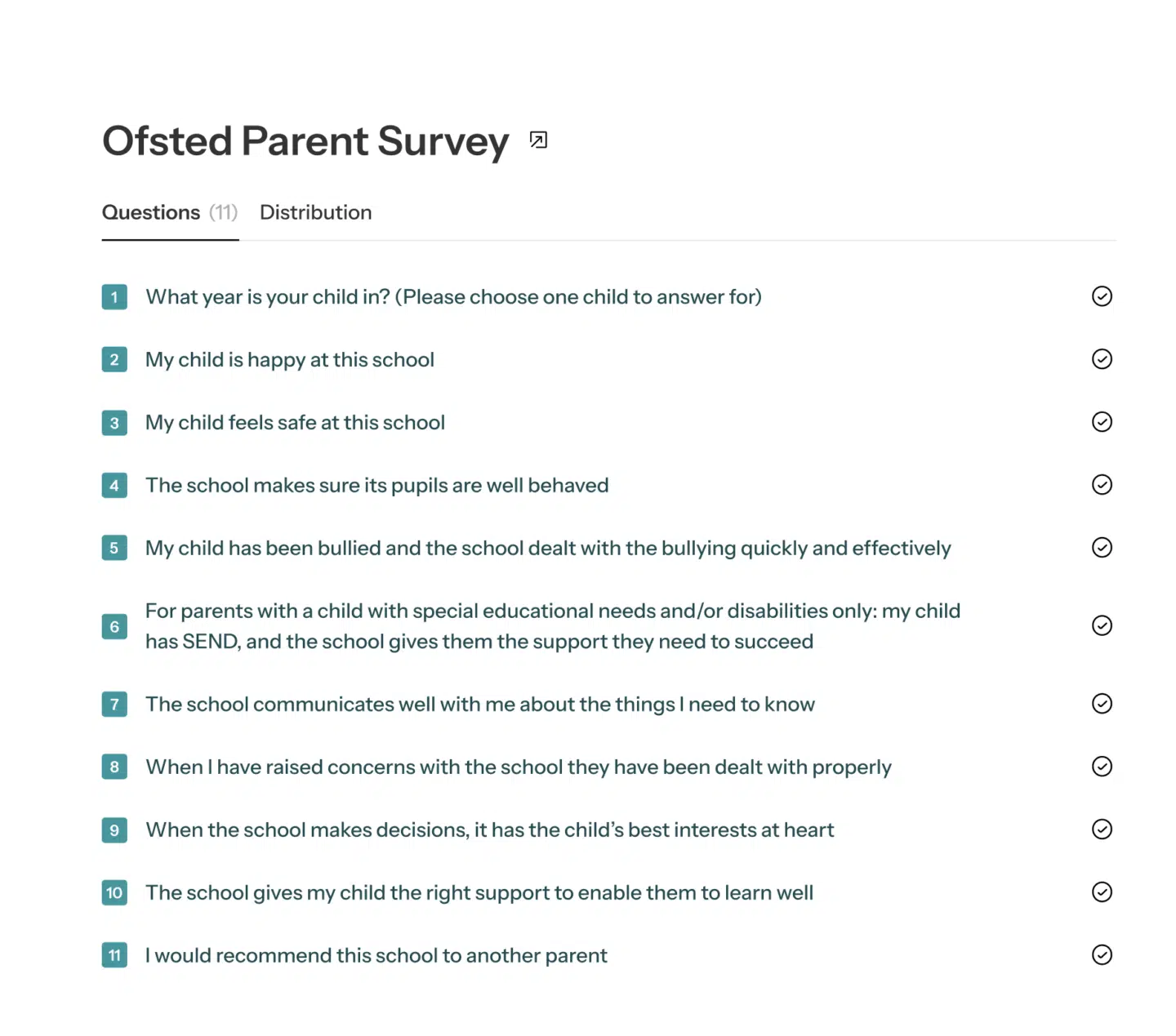
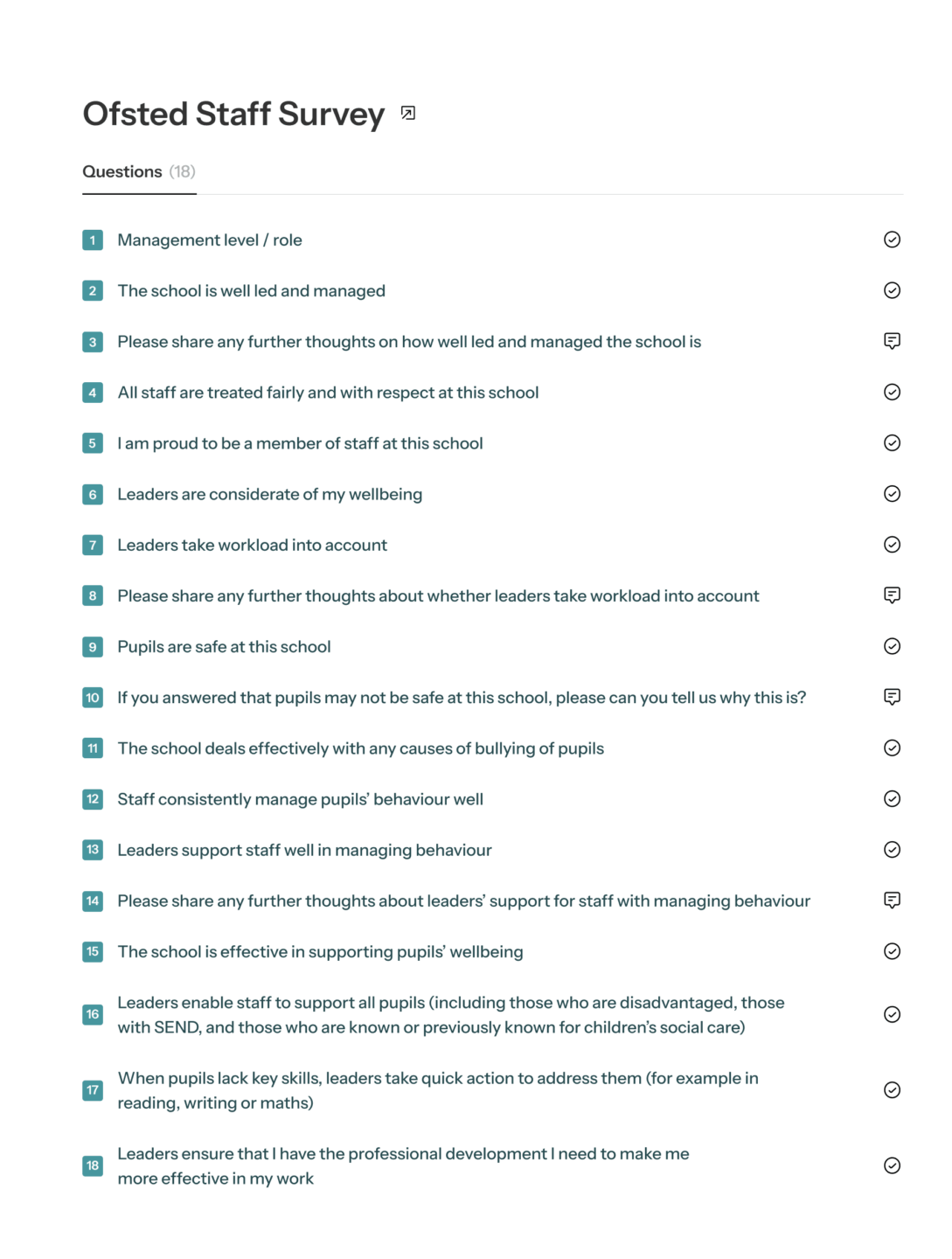
Some leaders like to have run these Ofsted questions outside of inspection, particularly if they are in a likely window, to have a sense of what staff will say. The official template is ready in the portal to make this very quick and easy to do, covering all 14 questions, and including the space for optional additional comments on the four questions where this is relevant.
You might also like to add in a few other questions of your own – perhaps tracking something in a bit more depth, and/or taking the chance to capture some positive feedback with an open question.
Questions to consider dropping, swapping or adding
The Management level / Role question
The official Ofsted survey gives respondents six categories of role:
- Headteacher/Principal
- Senior leader
- Middle leader
- Teacher
- Support staff – teaching
- Support staff – other
Whilst this may seem useful for leaders to analyse in detail, it can backfire if people feel uncomfortable identifying themselves, especially in a smaller school where there aren’t many people in their category.
We usually recommend only asking people to identify as “Teacher” or “Support Staff”. This helps protect anonymity, which in turn is likely to boost response rates and honesty. You can use any of our role split questions (with 2, 3, 4 or 6 options), or write your own.
Double-barrelled questions
At Teacher Tapp, we try to avoid what we call ‘double-barrelled’ questions, that cover more than one idea within the same question. They are frustrating to try and answer, and the data isn’t as clear.
Here’s an example from the newest Ofsted survey:
“Staff at this school are treated fairly and with respect”
This merges two concepts: being treated fairly and staff treating each other with respect. This makes it hard to know what people feel about each aspect separately. In the portal, we offer the two separately:
My school treats all employees fairly
and
Staff at this school treat each other with respect
Each is benchmarked with separate national Teacher Tapp data, giving you relevant insight into what your own staff are saying, matched by responses from staff in schools of the same phase and FSM quartile.
Another example is the professional development question: “Leaders ensure that I have the professional development I need to make me more effective in my role”
We have separate ones in the portal (amongst lots of other professional development questions):
I can access the professional development I need
and
Professional development I have accessed in the past 12 months has helped me improve in my role
Vague feeling questions
General statements like this are quite hard to get to grips with:
“Leaders are considerate of my wellbeing”
If you want to measure and track meaningful action, you may wish to look at some of our preferred more specific questions. For example:
If I approached my line manager with concerns about my mental wellbeing, I’m confident I would be well supported
or
Currently, who do you feel appreciated by? [list]
Likewise, what are you going to learn from how people answer this one?
“When pupils lack key skills, leaders take quick action to address them”
You might want to drop it from your own survey, even if Ofsted will be asking it when they come. More interesting could be asking staff something specific, like what they did in their last lesson for retrieval practice, or which aspects of Adaptive Teaching they are making most/least progress with implementing.
So, where does an Ofsted survey fit with your survey schedule?
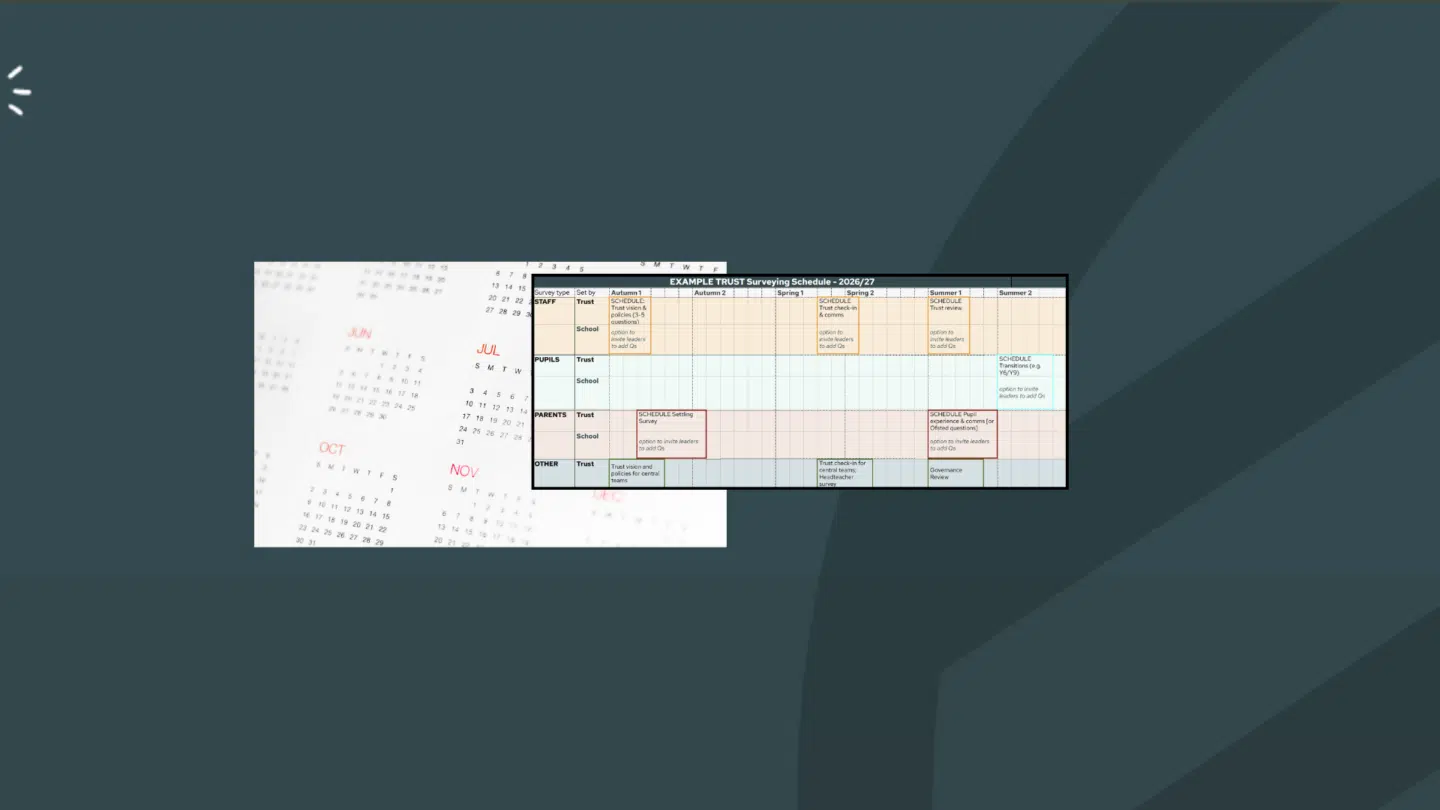
If you are running a schedule of 3 – 6 surveys over the year anyway [see here for a suggested schedule], you can easily slip in some or all of the Ofsted questions in one of these slots.
There may be whole areas that you want to probe more deeply, and ask more specific questions about. Our Behaviour Barometer template or Professional Development Review could be really useful.
Most importantly, think about the year as a whole, the areas you most want to track and how much surveying you actually have space and energy for. There’s no point in sending out lots of surveys if you don’t intend to refer to the results at all. People will soon get tired of them and stop answering.
Successful surveying is part of a healthy dialogue, where you commit to sharing results, even if sometimes the hard message isn’t “You Said, We Did”, but more of a “You Said, We’re Doing This Instead First” – explain your priorities, back yourself and be realistic about your team’s capacity.
Further ideas and support
You may also find our recent series on survey data to support Self Evaluation useful. We point to areas where survey data (from staff, parents and pupils) can help you tell the story of how your school is performing and improving.
If you are an existing member of School Surveys, remember that you can always email us or book a call if you’d like any help. If you aren’t yet a member and are interested to find out more, please get in touch via hello@schoolsurveys.com.