
Leadership and governance run through every aspect of a school’s effectiveness. While Ofsted no longer requires a specific Self-Evaluation Form (SEF), inspectors remain clear that they expect leaders to know their school well, understand how leadership is experienced by staff, and be able to show how feedback informs improvement.
This blog is part of a short series exploring how school survey data can support different areas of self-evaluation. Here, we focus on Leadership & Governance, and how staff survey data can provide robust, inspection-relevant evidence to support leaders’ own evaluation.
What Ofsted is interested in
In the School Inspection Handbook, Ofsted emphasise leadership culture, staff engagement and decision-making. Inspectors routinely explore:
- Whether staff have confidence in leaders
- How well leaders communicate priorities and expectations
- Whether staff feel listened to and supported
- How leaders respond to concerns and feedback
Staff surveys cannot – and should not – stand alone. But when used thoughtfully, they offer an important perspective on how leadership is experienced across the organisation, not just by those closest to senior teams.
Two key metrics for Leadership & Governance
Within School Surveys, two staff metrics are particularly useful when reflecting on leadership and governance:
1. Staff confidence in decisions made by the SLT
This metric provides a high-level indicator of trust. It is not about unanimity or avoiding challenge; healthy schools often have disagreement. Instead, it reflects whether staff believe decisions are considered, purposeful and aligned with the school’s values and priorities.
Where confidence is lower, leaders frequently find that the issue lies less with the decisions themselves and more with communication: staff may not understand the rationale, the evidence base, or how decisions connect to the wider school improvement plan.
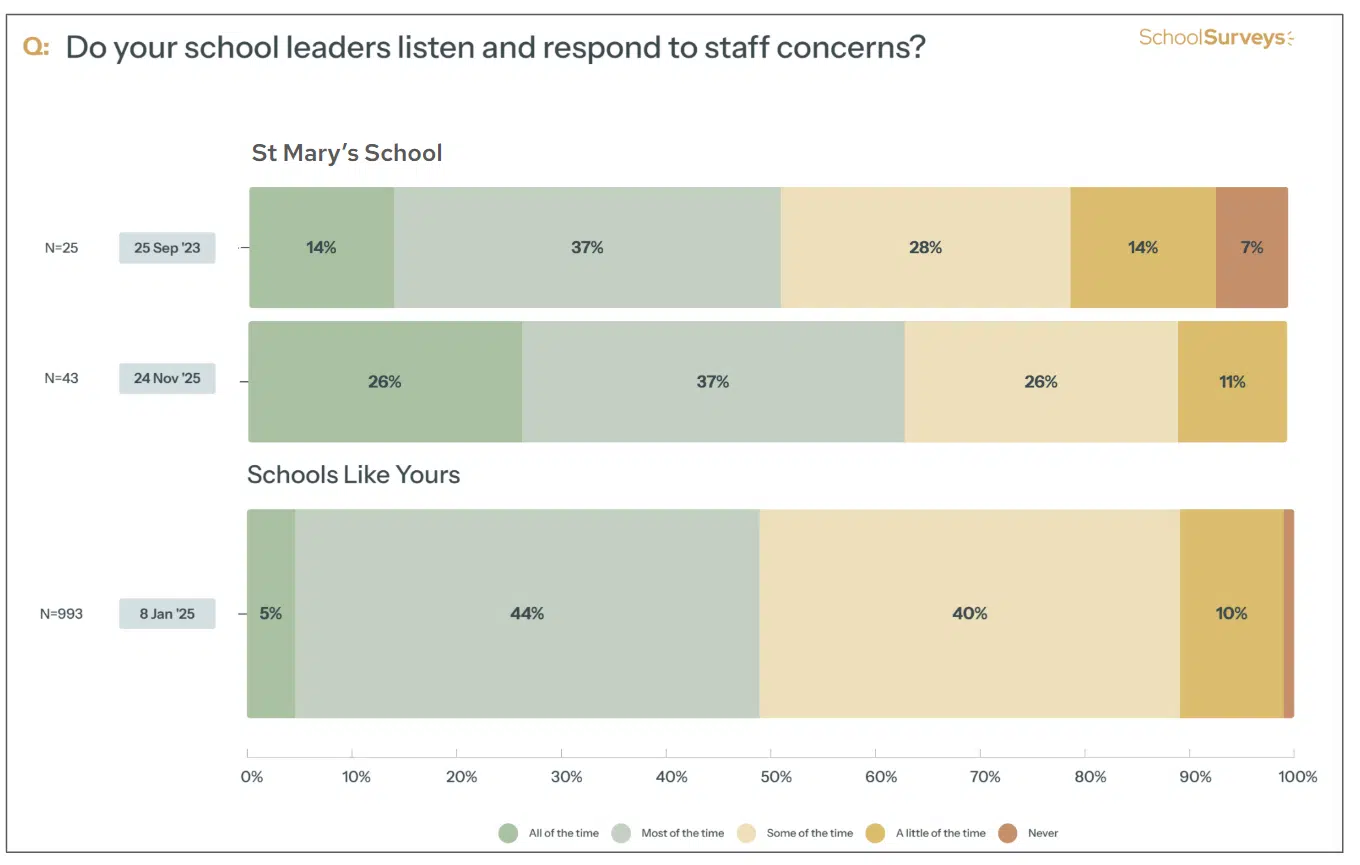
2. Leaders listen and respond to staff concerns
Ofsted are clear that staff voice matters, particularly in relation to workload, wellbeing and professional culture. The proportion of staff who feel leaders listen and respond offers a powerful proxy for psychological safety and organisational trust.
This measure becomes especially meaningful when tracked over time. Improvements here often reflect deliberate leadership actions: clearer routes for raising concerns, greater visibility of senior leaders, or explicit follow-up to previous survey feedback.
Making the data work for your SEF
For Leadership & Governance, survey data is most effective when it is:
- Benchmarked, so leaders understand whether results are broadly typical or a cause for concern
- Triangulated with other evidence such as staff turnover, absence, exit interviews and meeting records
- Used formatively, with leaders able to point to specific actions taken in response to feedback
Inspectors are less interested in perfect scores and more interested in whether leaders are reflective, responsive and improving. Used well, staff survey data helps leaders articulate not just what they are doing, but how it is experienced – strengthening self-evaluation and providing credible evidence of leadership impact.
Further ideas and support
There are lots of other posts that you may find useful here in the School Surveys blog, including boosting parent responses, support with survey planning and our summary of surveying and the new Ofsted framework.
If you are an existing member of School Surveys, remember that you can always email or phone us or book a call if you’d like any help.
If you aren’t yet a member and are interested to find out more, please book a demo here, or get in touch via hello@schoolsurveys.com.


