Ofsted pupil survey questions
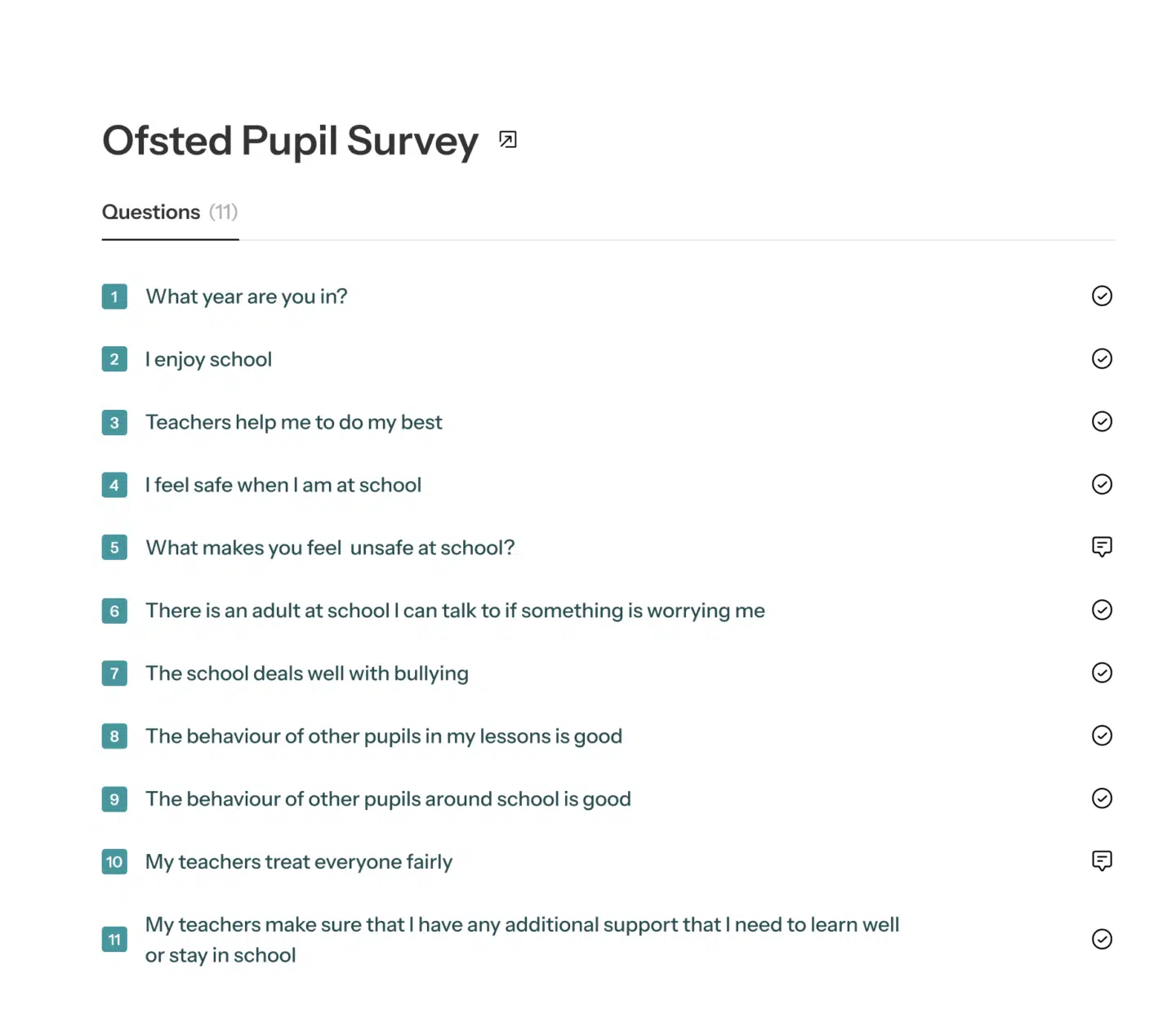
The official Ofsted pupil survey asks 11 questions: one about which year the pupil is in, nine statements to agree or disagree with, and one open text box. They cover enjoying school, feeling safe, behaviour in lessons and around school, bullying, fairness and support with learning. Here is the full list. With School Surveys Essentials, you can also add an open question and positive question from our question bank to gain even more insight from your survey.
What questions are in the Ofsted pupil survey?
- What year are you in?
- I enjoy school
- Teachers help me to do my best
- I feel safe when I am at school
- What makes you feel unsafe at school? (free text)
- There is an adult at school I can talk to if something is worrying me
- The school deals well with bullying
- The behaviour of other pupils in my lessons is good
- The behaviour of other pupils around school is good
- My teachers treat everyone fairly
- My teachers make sure that I have any additional support that I need to learn well or stay in school
Surveying pupils
Why ask pupils directly?
Pupils notice things adults do not. They know which corridors feel unsafe, which lessons they can ask for help in, and whether the behaviour policy is applied the same way to everyone. The pupil perspective gives leaders another view of how things are going, and is particularly interesting to triangulate alongside views from staff and parents.
How can I share the survey with pupils?
Through School Surveys Essentials, you can set you this survey in minutes and have links, QR codes and printable posters ready to share. Students can complete it in school or in their own time, with much stronger completion rates if done within allocated time at school.
Making sure pupils answer honestly
Pupils are quick to work out what answer an adult is hoping for. A few things help:
- Say clearly that responses are anonymous (remind them of other ways to talk to a trusted adult rather than making disclosures in the survey)
- Consider having someone other than their own class teacher introduce it where you can
- Ask them to complete the survey without any discussion and give them enough time that it does not feel like a race
- Tell them afterwards what you found and what changed as a result
That last one matters more than the rest put together. Pupils who saw something change after the last survey are more likely to engage with the next one.
Safeguarding considerations
Question 5 is an optional open one: What makes you feel unsafe at school?
Open questions can be useful for uncovering views or ideas that you hadn’t thought of or asked about directly. However, it is worth reminding pupils that this is a completely anonymous survey and that they should talk to a trusted adult if there is anything they are worried about.
The final csv file allows you to track the date and time of each individual survey submission, so only shows how each individual has completed the whole survey, rather than who that individual is.
The question can be deleted if you do not wish to collect open text responses.
Reading and sharing the results
How do I get the results?
Responses appear in real-time as they are submitted, viewable in your online portal with School Surveys. A final report is also sent to your inbox automatically as soon as the survey closes.
We show the responses in graph and table format, giving you the visual picture of the main findings alongside the full data. Open-text questions are summarised to give you the main themes, with the full sets of responses also available online and in the appendices of the PDF reports. You should think carefully about who you give access to in case pupils share anything inappropriate.
Can I review results by year group?
The first question allows you to analyse results by year group. Pupil experience often varies far more between year groups than a whole-school average suggests, and the gap between the happiest and unhappiest year is usually more informative than the overall score.
A dip in a particular year is worth investigating rather than averaging away. It often points at something specific — a transition that is not working, a year team under strain, a timetable quirk nobody has noticed.
With School Surveys, you can filter the results, review the data and therefore actively respond to the feedback you receive.
How does my school compare to others?
With School Surveys, we have benchmark data for all these questions from the schools who are using our service for all their surveying. We’ve made the question 4 benchmark (I feel safe when I am at school) available through our Essentials offer, so you can see how the responses you receive to this question compare to other similar schools by phase and FSM quartile.
Is it really free?
Yes! School Surveys Essentials allows you to run the Ofsted surveys whenever you need to. It is our free level of access and there is no limit to when or how often you run these surveys.
If you want more benchmarks, or want to use School Surveys for other surveys you run throughout the year, then you can move onto a paid subscription and benefit from all our templates, tools and school surveying expertise. Paid access also allows you to write your own questions.
Email us on hello@schoolsurveys.com to change your access, or book a quick call with us if you’d like to see more of the site or ask any questions.
The other Ofsted questionnaires
All three are available free in School Surveys Essentials, from School Surveys by Teacher Tapp.