Trust Guidance: Deciding On Your Approach
When your trust signs up for School Surveys, you have the flexibility to survey your schools all together or in any combination that suits you. You are also able to invite your individual schools to add their own questions to surveys that you create (Joint Surveying) if you wish. This page outlines the different approaches that you may choose to take, together with templates to support your scheduling.
Trust-only surveying
The Trust portal allows for someone in the Trust’s central team to create and allocate surveys, for staff, parents or pupils, at any number or combination of the Trust’s schools.
The Trust administers and distributes all surveys themselves or via our system. Surveying is usually managed by someone in the central team such as an HR Manager or an Improvement lead. This person may liaise with other Trust leaders to decide on the schedule and content of different surveys for the year, and is the key point of contact with the School Surveys team. This option does not require the involvement of anyone from the individual schools to run the survey(s) if the Trust prefers to manage the process centrally.
An overview of the year’s plans might look like this example, imagined for the “Teacher Tapp Trust”:

An editable template to support this type of planning can be found here.
Each Trust-wide survey generates a Trust report, showing the overall Trust performance, as well as school comparisons within the Trust, and alongside each school’s own Teacher Tapp driven national benchmarking data (matching their phase and FSM quartile).
The surveys also generate individual reports for each school, which can be accessed by the schools via their portal login. Some Trusts have chosen also to take responsibility for sharing the individual school reports with the schools rather than inviting the individual school leaders into their school’s portal.
An advantage of this approach is its simplicity – both in administration and strategic alignment. That said, many Trusts also want individual schools to explore issues most pertinent to their situation, which is where a mixed approach may be useful.
Mixed approach
This is currently our most common approach with Trusts, where the Trust runs a Trust-wide survey across its schools, and the individual schools also run their own surveys separately as they wish throughout the year.
Some Trusts run one annual survey; some run an autumn and summer survey; some even more frequently. Particularly with the more frequent surveying, we advise using a Surveying Schedule in order to help the Trust and schools plan and coordinate their surveying.
Complementary to this, individual school use of surveying allows school leaders to choose the frequency, style and content of surveying that suits them and the priorities that they are working on locally. We work with the Trust to ensure we do all we can to facilitate and support this – agreeing a plan for how to invite school leaders into the platform and providing online training sessions for groups or individuals.
Here’s an example of a plan co-created by the Teacher Tapp Trust and one of its individual schools, School A:

Joint surveying
Here the Trust sets a survey, allocates it to its schools and invites the individual school leaders to preview it and add questions of their own if they wish to. For example, there may be something a school wants to track progress on from last year, or a strand of the SDP that feels particularly important to take views on.
Once the survey has been scheduled, and before it opens, there is scope for individual school leaders to make changes to the survey:
- Add questions of their own. They cannot edit or delete the questions set by the Trust.
- Change the survey open date. Whilst the overall surveying window is set by the Trust, at a school level they may want to shift the start date and notifications within this, for example, opening earlier to allow for completion during a particular staff meeting or training time.
- Change the survey close date. Again, they cannot go outside of the Trust’s survey window, but they may choose to close their survey earlier than the Trust date if they wish to generate their own report earlier than the Trust’s end date.
Here is an example of a start of the year survey set by a Trust (on the left), with the additions an individual school has made (on the right):

An advantage of this approach is that the Trust sets of the overall agenda and parameters to ensure important engagement milestones are met, whilst the school gets the chance to personalise to their situation without needing to manage the overall process. Respondents across the schools get one simple link to follow, allowing them to share their views for the Trust and the school without needing to complete multiple surveys.
School-only surveying
Finally, some Trusts have facilitated access to School Surveys for their schools but have preferred to leave surveying operating only at the individual school level. Below is an example of an individual school’s surveying plan for the year ahead:
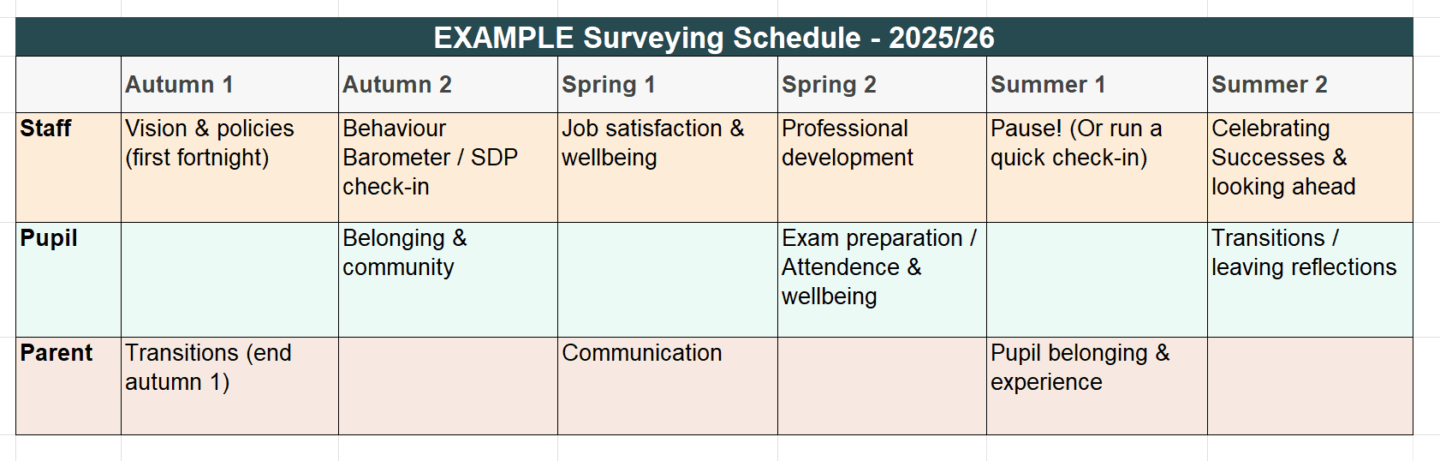
At its simplest, individual schools may like to download and edit this template to formulate their own separate plans. This blog post, Successful Surveying: The Perfect Plan, is designed to support individual school leaders with thinking through their school’s approach. Even in this scenario, the central team may like to use the Trust portal to have visibility of the surveys that schools run and the reports that are generated.
Further support
If you would appreciate help in thinking through the approach that will work for your Trust and schools, please get in touch at help@schoolsurveys.com or call us on 0330 043 4469 and our team will be more than happy to help.